
Mold Remediation in Vandenberg Village
Mold remediation in Vandenberg Village and surrounding areas. Insurance billing accepted. Call (805) 345-7440.
That musty smell you noticed after the winter rains — the one that won’t go away even after you’ve cleaned — is often the first sign that mold has already colonized behind drywall, under subfloor, or inside wall cavities. Mold can begin growing on wet building materials within 24 to 48 hours of a moisture event, and by the time it’s visible or detectable by smell, the colony is usually well established. Mold remediation is not surface cleaning. It is the systematic removal, containment, and verification of fungal contamination in a way that prevents cross-contamination to unaffected areas and confirms clearance before walls go back up.
What mold remediation actually involves
Remediation starts with understanding the scope of the contamination — not just what you can see, but what’s hidden. Mold grows where moisture goes, and moisture in a building rarely stays where you expect it. A slow roof leak in Vandenberg Village’s coastal-influenced climate can saturate insulation and OSB sheathing for weeks before any visible staining appears on the ceiling below. A failed dishwasher supply line soaks the kickplate, the toe-kick, and the bottom of the adjacent cabinet box long before the homeowner notices warping.
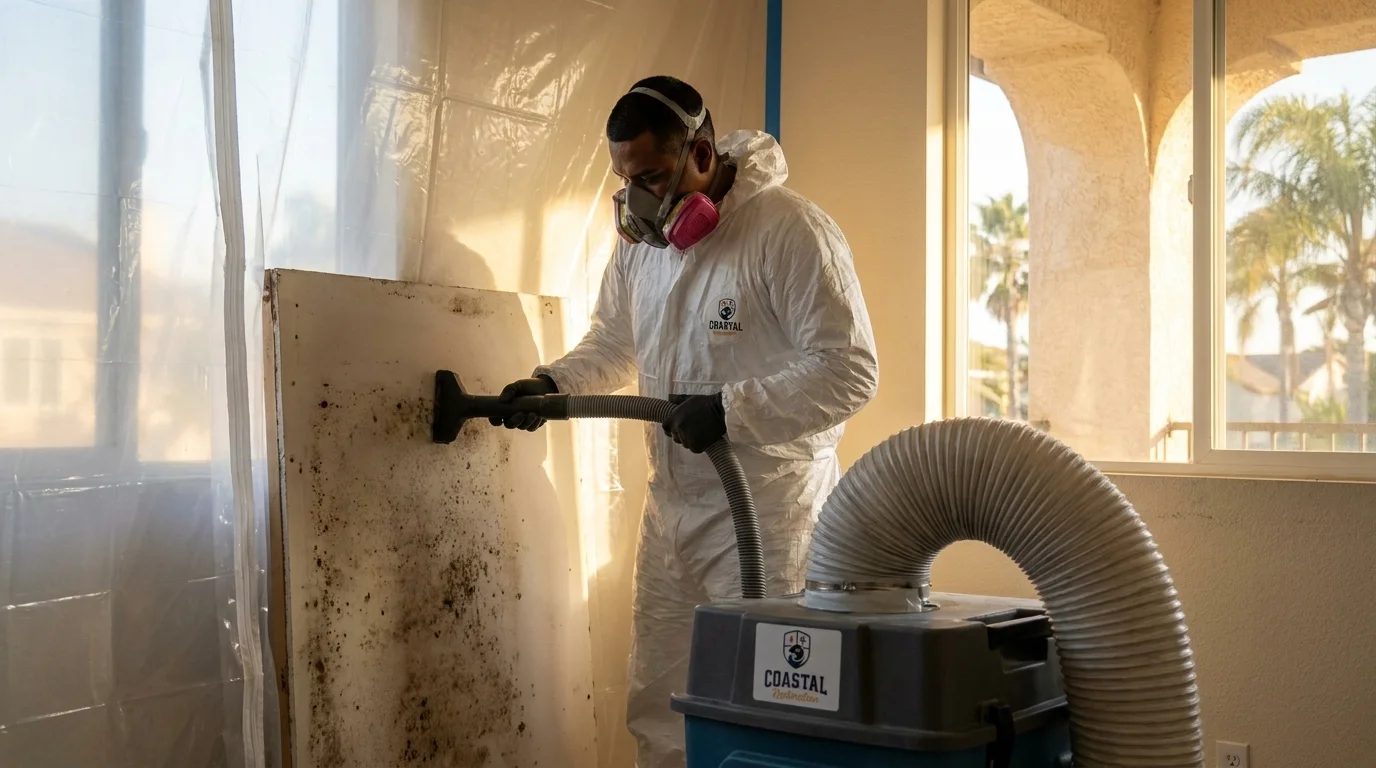
The remediation process uses physical containment barriers (typically 6-mil poly sheeting with negative air pressure) to isolate the work zone, HEPA-filtered air scrubbers running continuously during demo to capture airborne spores, and wet-wipe or HEPA-vacuum removal of contaminated materials. Porous materials — drywall, insulation, carpet — that have active mold growth are removed and bagged for disposal. Semi-porous materials like wood framing are wire-brushed, HEPA-vacuumed, and treated with an EPA-registered antimicrobial. The work zone stays under negative pressure until clearance air sampling confirms spore counts have returned to acceptable levels.
Timeline depends on scope. A single bathroom with mold behind the tile surround might take one to two days. A crawlspace with widespread fungal growth across the joists and subfloor can run four to seven days, plus drying time if the moisture source hasn’t been fully addressed.
Our process
-
Moisture source identification and assessment. Before any mold is touched, the source of moisture feeding it must be located and stopped. Remediating mold without fixing the leak, the vapor intrusion, or the HVAC condensation issue is a temporary fix. We use moisture meters and thermal imaging to map the extent of saturation.
-
Containment setup. The work area is isolated with poly sheeting, zipper-door entry barriers, and negative air pressure maintained by HEPA-filtered air scrubbers exhausting to the exterior. This prevents spores disturbed during demo from migrating into unaffected rooms.
-
Controlled demolition and material removal. Contaminated porous materials are removed in manageable sections, double-bagged, and sealed before transport through the living space. Framing and structural members with surface mold are cleaned in place using wire brushing, HEPA vacuuming, and EPA-registered antimicrobial application.
-
HEPA air scrubbing and drying. Air scrubbers run throughout the project and for a dwell period after demo is complete. If any residual moisture remains in structural materials, drying equipment is deployed to bring moisture content to acceptable levels before reconstruction begins.
-
Clearance testing. Post-remediation air sampling or surface sampling is conducted — ideally by a third-party industrial hygienist — to verify that spore counts in the remediated area are comparable to or lower than outdoor baseline levels. Work is not considered complete until clearance is confirmed.
What separates a good mold remediation response from a bad one
The most common failure in residential mold remediation is inadequate containment. Cutting into a mold-contaminated wall without negative air pressure and proper barriers can distribute millions of spores through a home’s HVAC system in minutes, turning a localized problem into a whole-house issue. Insurance adjusters and industrial hygienists look for documentation of containment setup, air pressure differentials, and equipment logs — not just before-and-after photos.
A second common shortcut is skipping clearance testing. Some contractors declare the job done after visual inspection. Visual inspection alone cannot confirm that airborne spore concentrations are safe. Proper clearance requires air or surface sampling, and those results should be in writing.
A third issue is remediating without addressing the moisture source. If the roof still leaks, the crawlspace still has vapor intrusion, or the bathroom exhaust fan still vents into the attic, mold will return within one to two rainy seasons. A thorough remediation scope includes a written moisture source finding, not just a mold removal line item.
What does mold remediation cost?
Typical costs for mold remediation vary significantly based on the size of the affected area, the type of materials involved, and whether structural demolition is required. Most homeowners pay somewhere in the ranges below — these are industry-typical figures, not quotes.
| Scenario | Typical range |
|---|---|
| Single bathroom, surface mold on tile/grout | $500 – $1,500 |
| Single room, mold behind drywall (limited demo) | $1,500 – $4,000 |
| Crawlspace mold on joists and subfloor | $3,000 – $8,000 |
| Attic mold (decking and rafters) | $2,500 – $7,000 |
| Multi-room or whole-house contamination | $8,000 – $30,000+ |
| Post-remediation clearance testing (third-party) | $300 – $800 |
Every loss is different — square footage, material types, moisture history, and access conditions all affect the final scope. Coastal Restoration Services Inc provides a written scope of work before any remediation begins so there are no surprises. Homeowners insurance coverage for mold varies by policy: most carriers cover mold that is a direct result of a covered sudden water loss (burst pipe, appliance failure) but exclude mold from long-term neglected leaks or flooding without a separate flood rider. Documentation of the moisture source is often the deciding factor in whether a claim is approved.
Seasonal and regional considerations
Vandenberg Village and the surrounding Santa Barbara County coast sit in a climate that moderates temperature extremes but delivers concentrated moisture in winter and early spring. The marine layer keeps humidity elevated even in dry months, and homes with poor attic ventilation or vapor barriers in crawlspaces that were installed decades ago are particularly vulnerable. After the region’s rainy season — typically November through April — mold assessments spike as homeowners discover what the winter moisture did behind walls and under floors. Homes built in the 1960s and 1970s that are common in Lompoc and the surrounding communities often lack modern vapor barriers and use paper-faced insulation that mold colonizes readily.
Service area
Coastal Restoration Services Inc is based in Vandenberg Village and provides mold remediation throughout the surrounding region, including Lompoc, Santa Maria, Orcutt, Buellton, Solvang, and Goleta. The city-specific pages for each area link back here for the full technical detail on our remediation process.
If you’re seeing discoloration on drywall, smelling mustiness after rain, or dealing with the aftermath of a water loss that wasn’t fully dried out, call (805) 345-7440 to request an air quality assessment. The sooner the moisture source and contamination extent are mapped, the smaller the remediation scope — and the lower the cost.
Frequently Asked Questions
Does homeowners insurance cover mold remediation?
What is the difference between mold removal and mold remediation, and does it matter?
What level of mold contamination requires full containment with negative air pressure?
How do I know the mold remediation actually worked? What is clearance testing?
Can mold come back after remediation, and what prevents it?
Looking for the best mold remediation company in Santa Maria?
Coastal Restoration Services Inc provides mold remediation in Santa Maria, CA and the surrounding area. Customers rate us 5.0 out of 5 stars across 29 Google reviews. We answer calls 24/7 — call (805) 345-7440 for immediate help.
Need Mold Remediation now?
We respond 24/7 across Santa Maria and surrounding CA cities.
Related Coverage
- Our Restoration Services
- Contact Coastal Restoration Services Inc
- Mold Remediation in Arroyo Grande
- Mold Remediation in Atascadero
- Mold Remediation in Avila Beach
- Mold Remediation in Ballard
- Mold Remediation in Blacklake
- Mold Remediation in Buellton
- Mold Remediation in Callender
- Mold Remediation in Cambria
- Mold Remediation in Edna
- Mold Remediation in El Paso de Robles
- Mold Remediation in Grover Beach
- Mold Remediation in Guadalupe
- How To Choose a Restoration Company in (Without Getting Burned)
- How To Test for Mold in Your Home (DIY Kits vs a Pro Inspection)
- 7 Signs You Have Hidden Mold (and What To Do Next)