
Vandalism Cleanup in Santa Maria
Vandalism cleanup in Santa Maria and surrounding areas. IICRC-certified, insurance billing accepted. Call (805) 345-7440.
You walked out to your car, your storefront, or your property this morning and found it — spray paint across the siding, a smashed window, a door kicked in, maybe worse. The damage itself is jarring, but what most people don’t realize is that the clock starts immediately: aerosol paint begins bonding to porous surfaces within hours, broken glass creates hidden secondary hazards, and an unaddressed vandalized property signals to opportunists that no one is watching. Fast, methodical cleanup isn’t just cosmetic — it’s how you stop a single incident from becoming a pattern.
What vandalism cleanup actually involves
Vandalism rarely leaves just one type of damage. A typical job might combine spray-paint graffiti on stucco or block wall, broken glass from a window or storefront door, forced-entry damage to door frames and locks, and debris scattered across the property. Each material requires a different approach.
Graffiti removal depends entirely on the substrate. Painted block, raw concrete, sealed stucco, glass, metal, and wood all respond differently to chemical degreasers, pressure washing, and abrasive media. Using the wrong solvent on the wrong surface can drive pigment deeper into the pores or strip a protective coating that costs more to replace than the original graffiti removal. Broken glass cleanup goes beyond sweeping — tempered glass shatters into thousands of small cubes that migrate into soil, landscaping, and HVAC intake areas. Forced-entry damage often involves splintered wood framing, bent metal door frames, or compromised weatherstripping that won’t be obvious until the next rain.
Timeline matters here. Most latex spray paints reach full adhesion on porous masonry within 24–48 hours. Oil-based and enamel paints cure faster. The sooner removal begins, the higher the chance of a clean result without repainting the entire surface.
Our process
1. Site assessment and documentation Before anything is touched, every affected surface is photographed and measured. This documentation serves two purposes: it creates the evidence record your insurance adjuster will need, and it lets us identify all damage types present — including less-obvious items like paint overspray on landscaping, glass embedded in soil, or structural damage hidden behind cosmetic damage.
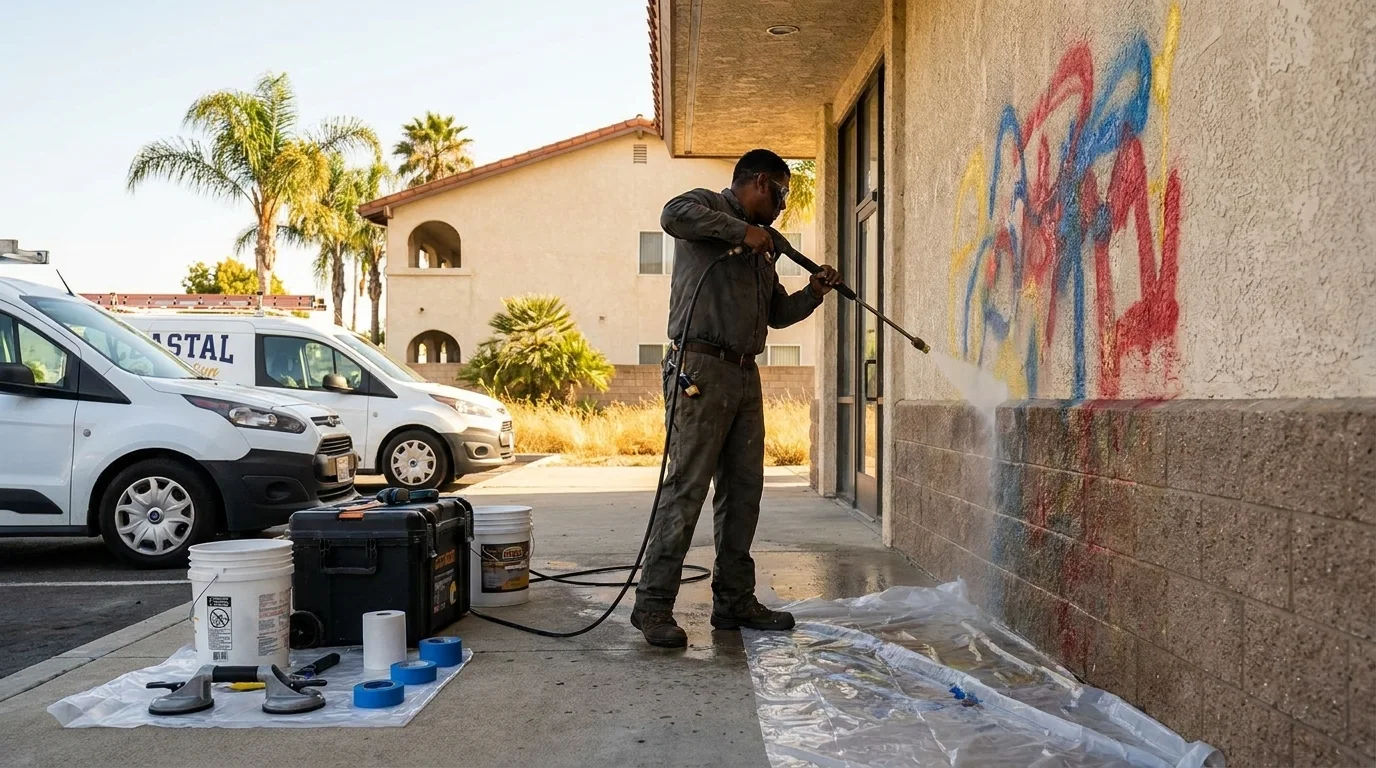
2. Surface-specific graffiti removal We match the removal method to the substrate. Sealed concrete and block typically respond to alkaline graffiti removers followed by pressure washing at controlled PSI. Unpainted stucco may require light abrasive media blasting. Glass and metal surfaces use solvent-based removers applied with controlled dwell time to avoid etching. Where chemical removal alone won’t restore the surface to pre-loss condition, we apply a matching anti-graffiti coating or coordinate repainting.
3. Broken glass and debris cleanup All visible glass is removed first, followed by a systematic sweep of the surrounding area — including soil, planters, and any HVAC or drainage areas downwind of the break point. We use commercial-grade vacuums with fine-particle filtration for interior glass, and we inspect window frames and door tracks for glass fragments that standard cleanup misses.
4. Forced-entry and structural repair coordination Door frames, locks, and any compromised structural elements are assessed and either repaired on-site or scoped for contractor follow-up. We document all forced-entry damage separately from cosmetic vandalism — insurance adjusters treat these as distinct line items, and combining them in a single vague description often leads to underpayment.
5. Final walkthrough and anti-graffiti coating Once surfaces are clean and repaired, we offer application of a sacrificial anti-graffiti coating on high-risk surfaces. These coatings allow future graffiti to be removed with water and a low-pressure wash, significantly reducing the cost and effort of any repeat incidents.
What separates a good vandalism cleanup response from a bad one
The most common mistake is treating vandalism cleanup as a single-trade job — pressure washing the graffiti and calling it done. Here’s what that approach misses:
Paint penetration into porous substrates. Untreated masonry absorbs aerosol paint quickly. Pressure washing alone on a porous surface often spreads the pigment rather than removing it. A technician who doesn’t test the substrate first and select the right chemical pre-treatment will leave a ghost image — a faint outline of the original graffiti that becomes visible every time the surface gets wet.
Glass migration. Tempered glass from a broken storefront door can travel 15–20 feet from the break point. Cleanup crews that only address the immediate area leave hazards in soil, drainage channels, and HVAC intakes that show up weeks later.
Incomplete damage documentation. Insurance adjusters for vandalism claims look for itemized documentation: each surface affected, the square footage of graffiti, the type of paint or marker used (aerosol vs. marker vs. etching), and photos taken before any cleanup begins. A claim submitted with only a general description and a total invoice frequently results in a partial payment or a request for supplemental documentation that delays your settlement.
Missing secondary damage. Forced entry often damages weatherstripping, subfloor thresholds, and door hardware that isn’t immediately visible. Overlooking these items means you’ll be paying for them out of pocket after the claim closes.
What does vandalism cleanup cost?
Typical costs run from a few hundred dollars for a single small graffiti tag on a sealed surface to several thousand for multi-surface commercial vandalism involving broken glass and forced-entry repair. Most property owners pay somewhere in the middle. The table below reflects typical industry ranges — your actual scope depends on surface types, paint penetration, and the extent of structural damage.
| Scenario | Typical range |
|---|---|
| Single graffiti tag, sealed surface (under 10 sq ft) | $200 – $600 |
| Multi-surface graffiti, residential exterior | $600 – $2,000 |
| Commercial storefront graffiti + broken glass cleanup | $1,500 – $4,500 |
| Forced-entry damage + graffiti + debris cleanup | $2,500 – $7,000 |
| Large-scale or repeat vandalism, multiple surfaces | $4,000 – $12,000+ |
Every loss is different — Coastal Restoration Services Inc provides a written scope of work before any work begins so you know exactly what is included. Homeowners and commercial property insurance policies typically cover vandalism cleanup under the “malicious mischief” or “vandalism and malicious mischief” peril, subject to your deductible; coverage for graffiti removal specifically is included in most standard policies but worth confirming with your carrier before work starts.
Seasonal and regional considerations
Santa Maria’s mild Central Coast climate means there’s no true off-season for vandalism incidents, but a few regional factors are worth knowing. The area’s stucco-heavy residential and commercial construction is particularly vulnerable to aerosol paint absorption — unpainted or lightly sealed stucco is one of the most porous common exterior substrates, and paint that sits overnight in warm, dry conditions bonds faster than it would in a humid coastal environment. Morning marine layer followed by afternoon sun also creates a wet-dry cycle that can drive partially-absorbed paint pigment deeper into masonry between the incident and the cleanup. Earlier response generally means better outcomes on stucco surfaces.
Service area
Coastal Restoration Services Inc is based in Santa Maria and serves surrounding communities including Orcutt, Lompoc, Guadalupe, Nipomo, Arroyo Grande, and Pismo Beach. Individual city-specific pages are linked from the service area section of this site — each covers any local considerations relevant to that community.
If you’re looking at graffiti on your wall, glass on your sidewalk, or a door that won’t close right, call (805) 345-7440 to begin your vandalism damage assessment. We’ll document the loss, walk you through the removal process for your specific surfaces, and give you a written scope before any work starts.
Frequently Asked Questions
Does homeowners insurance cover vandalism cleanup?
How quickly does spray paint bond to stucco or concrete, and does it matter how fast I call?
What's the right removal method for graffiti on stucco versus painted block versus glass?
How far does broken glass actually spread, and what areas get missed during cleanup?
What documentation does an insurance adjuster need for a vandalism claim, and how do I make sure I don't undermine my own claim?
Looking for the best vandalism cleanup company in Santa Maria?
Coastal Restoration Services Inc provides vandalism cleanup in Santa Maria, CA and the surrounding area. Customers rate us 5.0 out of 5 stars across 29 Google reviews. We answer calls 24/7 — call (805) 345-7440 for immediate help.
Need Vandalism Cleanup now?
We respond 24/7 across Santa Maria and surrounding CA cities.
Related Coverage
- Our Restoration Services
- Contact Coastal Restoration Services Inc
- Vandalism Cleanup in Arroyo Grande
- Vandalism Cleanup in Atascadero
- Vandalism Cleanup in Avila Beach
- Vandalism Cleanup in Ballard
- Vandalism Cleanup in Blacklake
- Vandalism Cleanup in Buellton
- Vandalism Cleanup in Callender
- Vandalism Cleanup in Cambria
- Vandalism Cleanup in Edna
- Vandalism Cleanup in El Paso de Robles
- Vandalism Cleanup in Grover Beach
- Vandalism Cleanup in Guadalupe